
Enterprise Portfolio Transformation
A multi-state critical infrastructure and industrial logistics operator overhauls a decade of legacy IT debt — led by Ron Le Mesurier, founder of Bilby Fusion.
# Illustrative image, not actual client site.
The Situation
The company — a multi-state critical infrastructure and industrial logistics operator — had spent years running on minimal capital IT investment. The result was a business carrying real, deep operational risk:
- Core applications were running on end-of-life server infrastructure, weeks away from losing all security and patch support.
- All core systems were hosted from a single site, with no backup or failover — creating an immediate single point of failure for the entire business footprint.
- Disparate, manual processes across branches governed customer quoting and order loops, causing widespread pricing inconsistencies.
- Siloed communication tools limited real-time collaboration and secure document mobility across multi-state operational teams.
None of this was hypothetical. It was tracked, scored, and owned — two high-priority, high-consequence risks sat open on the register with no mitigation in place when the engagement began.
The Approach
Rather than chase 26 disconnected projects (12 active, 14 planned) as a flat backlog, the transformation was organised into an 18-month roadmap across six clear capability pillars — sequenced across immediate, short, medium and long-term horizons. Managing a recovery operation of this scale meant breaking the traditional pattern of chasing standalone IT updates. We focused on decoupling applications from shifting vendor names, mapping out clear structural pillars that protected daily operations while enabling system modernization.
We engineered a highly visual alignment system that allowed business leaders to track dependencies in real time. Critical infrastructure backlogs and severe perimeter compliance gaps were isolated and staged first, building a secure operational environment before launching any user-facing automation suites or customer platform integrations.
- Microsoft 365 Collaboration, Identity & Document Management: Modern workspace boundaries covering Collaboration, SharePoint Document Management, Power Platform Automation, Entra ID security layers, and Intune Endpoint Control.
- Enterprise Applications: Core business evaluation pathways alongside mobile vehicle scheduling apps and legacy fleet system upgrades.
- Core IT Infrastructure: Cloud virtualization execution (IaaS), regional site client refreshes, and national data carrier line optimizations.
- Business Intelligence: Automated analytics pipelines connecting operational metrics and financial records.
- Order-to-Cash & Procure-to-Pay: Customer portal invoicing APIs, uniform quote layouts, and supplier automated verification loops.
- HCM & Project Governance: Post-merger cloud payroll integrations and structured ITIL/Project Support delivery models.
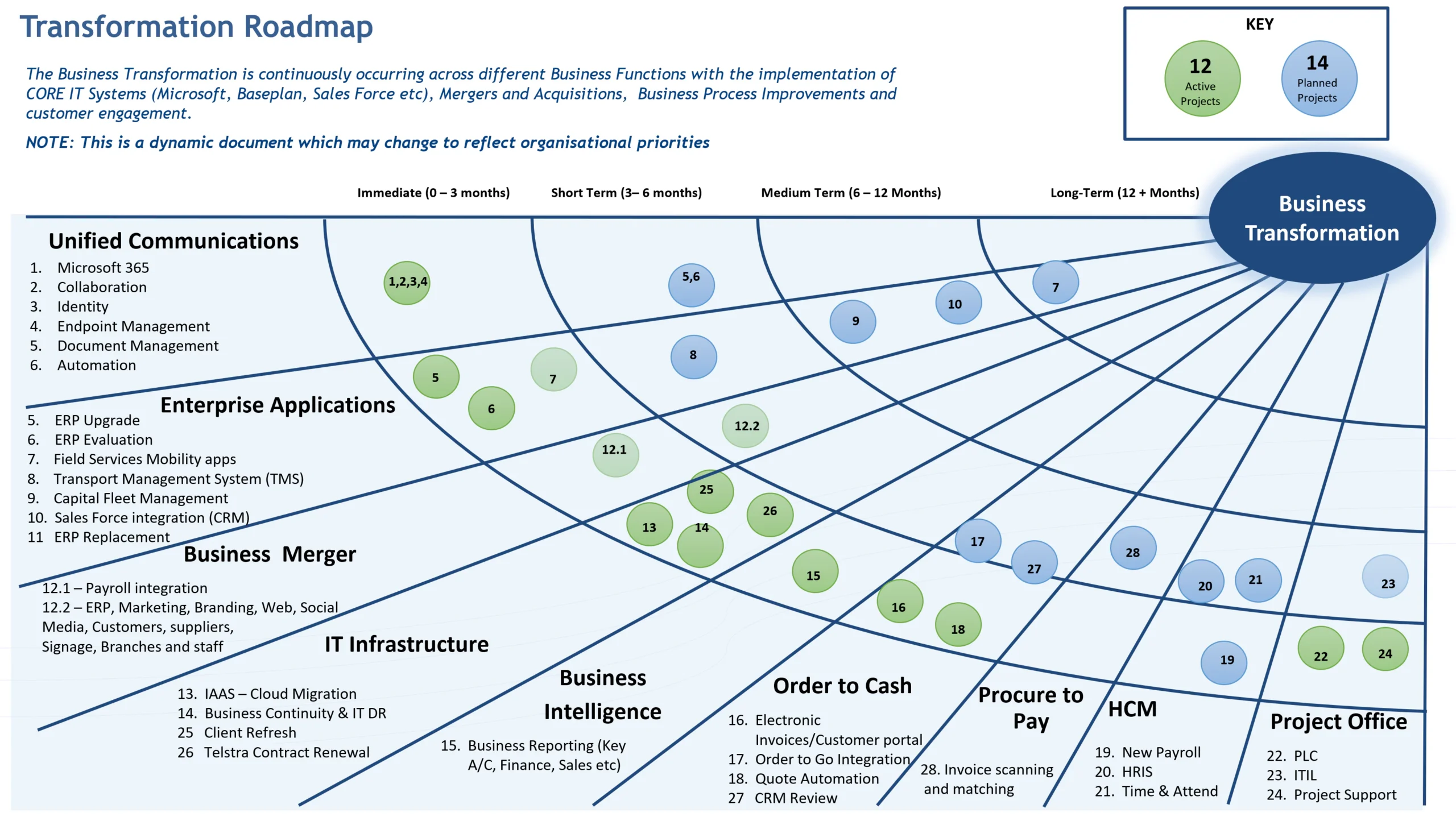
That structure meant priorities could shift — vendors get re-evaluated, projects get paused for good reasons — without losing sight of the overall runway. It completely eliminated the risk of ad-hoc project drift by anchoring every development back to specific, long-term operational capabilities.
Program Management Approach
Reversing a decade of structural infrastructure underinvestment required a disciplined, high-fidelity program management framework. To successfully insulate front-line logistics from execution friction, the portfolio was steered using three core operational controls:
Dynamic Priority Control
Decoupled engineering tasks from specific software products into broader capability streams. This protected project dependencies, allowing individual tools to be safely shifted without fracturing the broader roadmap timeline.
Horizon Timeline Staging
Organized active tracks into sequential horizons (Immediate, Short, Medium, Long-Term). Critical physical server vulnerabilities were fully enclosed and mitigated before rolling out customer-facing front-end invoicing or mobile apps.
Run-Rate Capital Funding
Enforced a strict cashflow-neutral velocity model. Savings generated from early infrastructure optimizations and carrier line cancellations were audited and immediately routed to fund parallel software scoping phases.
What Was Delivered
- Infrastructure risk, closed out: Proof-of-concept cloud servers were deployed to regional branches, with early results showing a 30% improvement in network performance and the elimination of recurring connection timeouts — directly addressing the single-point-of-failure risk sitting on the register.
- Telecoms costs, cut at the root: A full audit of the mobile and network carrier contract identified a substantial reduction in recurring spend — driven by cancelling unused mobiles, consolidating conferencing tools onto a single platform, decommissioning legacy fixed lines, and cutting data line costs.
- Core ERP integration delivered under budget: The core system integration — covering asset and fleet accounting configuration, UAT, training, and go-live — was completed under budget and on schedule, with a post-implementation review scheduled as standard practice rather than an afterthought.
- Honest governance, not vanity reporting: When the cloud email migration needed to pause to synchronise with a server upgrade — avoiding cutover risk and reducing total migration time — that delay was reported as a red status rather than buried. The same rigor applied across the portfolio: a live risk register with named owners, and a RAG-rated project tracker covering every workstream from ERP evaluation to disaster recovery.
- Groundwork laid for the next phase: ERP replacement options were shortlisted with vendor-provided cost estimates; a Business Continuity & IT Disaster Recovery track ran in parallel to infrastructure work, with submissions received from three hosting providers; and quote-to-contract automation was scoped to remove the manual re-keying causing pricing inconsistency across branches.
The Outcome
A business that had been quietly accumulating technical debt for years came out the other side with a robust operational foundation. By establishing clear ownership lines and replacing reactive maintenance with structured, capability-led deployment, the organization secured total transparency over its digital landscape.
Every active and pipeline initiative now runs within a standardized framework, ensuring that future expansions are built on reliable, predictable architecture. The business successfully minimized structural vulnerabilities while simultaneously unlocking performance capacity across its multi-state operations branches.